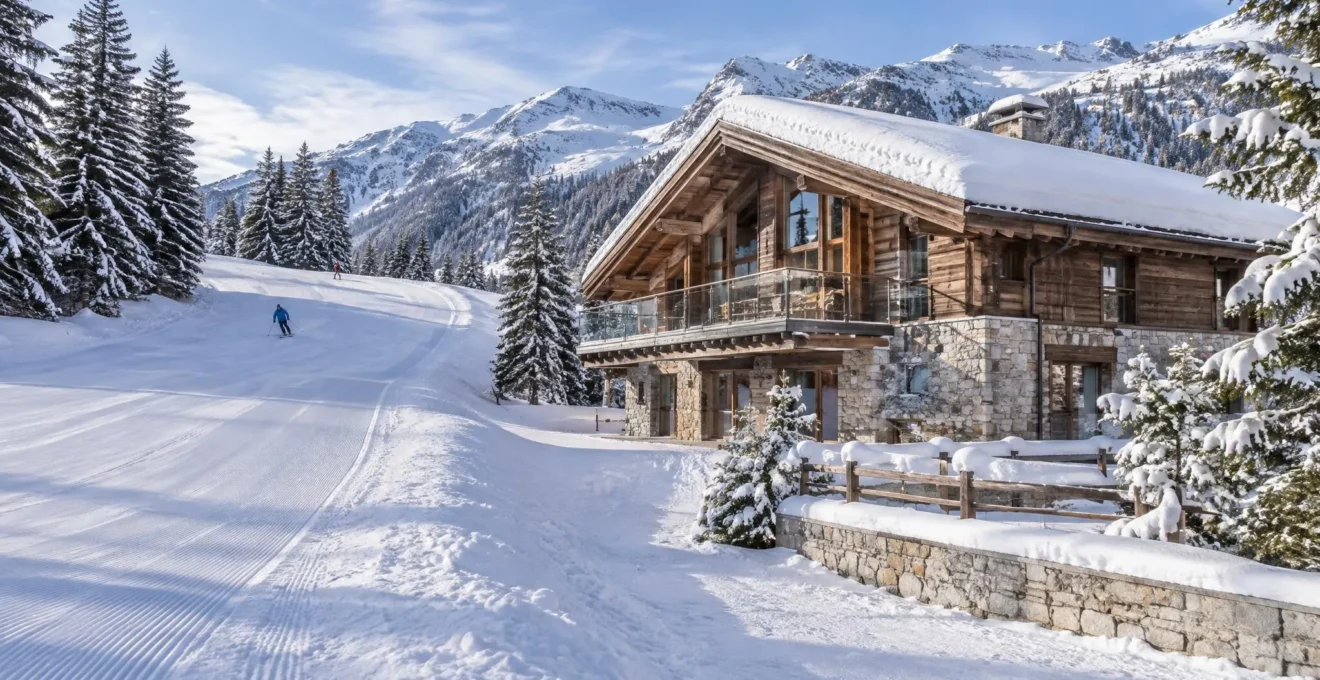
Before renting a ski-in/ski-out chalet in Courchevel, check the property’s exact location, trace the skiing routes out and back on an official piste map, and confirm that both routes suit your group. Look for walking sections, lift dependencies and seasonal restrictions, then ask the rental provider to clarify anything uncertain in writing.
A chalet described as ski-in/ski-out may offer convenient access without allowing you to ski directly from its door in every condition. The important question is not simply how close the slopes appear, but whether the complete journey works for your particular stay.
What does ski-in/ski-out actually mean?
The two parts of the expression describe different journeys. Ski-out concerns leaving the accommodation and reaching a usable piste on skis. Ski-in concerns returning to the property on skis after a day on the mountain.
They should be checked independently. A chalet may have a straightforward downhill departure but require a walk on the way back. Likewise, being beside a piste does not necessarily mean guests can reach it directly from the building.
| Description | What to check |
|---|---|
| Ski-out | Can you leave the property and reach a usable piste on skis? |
| Ski-in | Can you return from the ski network to the property on skis? |
| Ski-in/ski-out | Do both routes work, and under which conditions? |
| Near the slopes | Does the approach involve walking or carrying equipment? |
| Shuttle access | Where is the stop, and when does the service operate? |
These are practical distinctions, not a universal certification system. The most useful rental description identifies the actual connection rather than relying on a convenient-sounding label.
Find the chalet’s exact position on the piste map
The Courchevel ski-lift operator provides an English-language Courchevel piste map showing the local pistes and ski lifts. Use the map to identify the infrastructure near a proposed chalet, while remembering that it does not confirm the route from the property’s actual entrance. Check current opening information separately before skiing.
Start by asking for a precise map pin showing the chalet’s main entrance or ski room. An approximate location within Courchevel 1850 or another village is not sufficient: two properties in the same neighbourhood can have very different approaches to the slopes.
Find the nearest named piste, its direction and the lift needed to join the wider ski area. Look closely at the final section between the building and the marked route. A road, staircase, uphill path or cleared pedestrian area may require guests to remove their skis.
- Get the exact chalet entrance or ski-room map pin, not just the neighbourhood.
- Identify the nearest named pistes and lifts on the official map.
- Trace the ski-out and ski-in routes separately, noting any gaps.
- Mark uncertain private paths or connections for confirmation with the rental provider.
Satellite imagery may help reveal buildings and roads, but it cannot establish winter snow coverage or permission to use a particular access path. Use the map for infrastructure and the rental provider for property-specific details.
Compare the access descriptions in rental listings
When comparing chalet listings, check whether the description promises access directly onto a piste or simply places the property nearby. Altitude Courchevel Immobilier lists private chalets in Courchevel with differing locations and slope-access descriptions. These details can help narrow a shortlist, but the exact departure and return routes should still be checked on the piste map and confirmed for the individual chalet.
Pay attention to wording such as next to the piste, close to the slopes or ski-in/ski-out. Each deserves a different follow-up. For example, a chalet near a lift might provide excellent access after a short walk without offering direct skiing from the entrance.
Compare each property’s departure route, return route, piste difficulty and fallback arrangements. A direct connection that some guests cannot safely use may be less convenient than a manageable walk to an easier lift. Keep any property with an unclear return route on a provisional shortlist until the provider confirms the missing connection.
Test the route out and the route back
Once you have located the chalet, imagine the complete journey with boots, skis and poles. Check the outward and return routes as separate tasks, because a continuous piste connection in one direction does not establish the same convenience in the other.
Can you ski out from the actual entrance?
Begin at the ski room or entrance guests will use. Determine whether you can put on your skis there and reach a marked piste without removing them. If the route crosses a road, involves steps or requires walking, establish where that section begins and ends.
Check whether the connection reaches a suitable piste or simply leads towards a lift. A nearby lift can be convenient, but a pedestrian approach to it is different from skiing directly out.
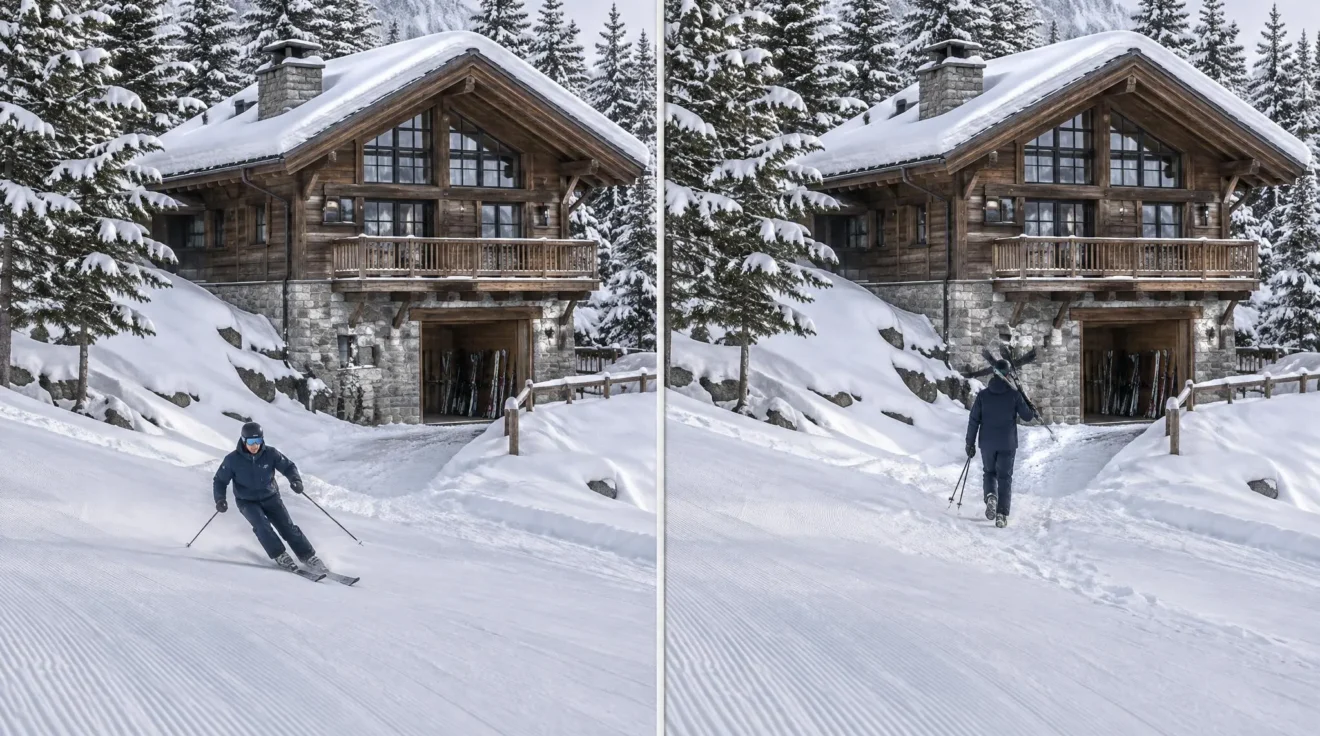
Can you ski back without a detour?
Trace the return from the pistes you expect to ski to the property itself. Identify the final connecting run, whether it requires a particular lift, and whether it finishes above, below or directly beside the chalet entrance.
An approach that is effortless when leaving may become an uphill walk when returning. Also check whether the final piste is suitable for everyone in your group and whether it remains accessible at your intended return time.
If the route is unclear, ask the provider to name the return piste and explain the final section in detail rather than simply confirming that the chalet is ski-in/ski-out.
Check that the connecting pistes suit your group
Direct access is only useful when guests can comfortably negotiate the connecting terrain. A chalet may be linked to the wider ski area by a piste that is too demanding for a beginner or a less confident skier.
Check the colour and marked difficulty of the relevant runs, paying attention to both departure and return. In French ski resorts, green and blue generally indicate easier marked pistes, while red and black identify progressively more demanding terrain. These classifications describe pistes, not the ability of every individual skier.
For a mixed-ability group, consider what the least confident participant will actually need to do. A family might reasonably prefer a short, manageable walk to an easy lift over a direct connection that requires an unsuitable descent.
Do not assume the difficulty of the resort’s main runs establishes the difficulty of a chalet’s own connecting route. Check the actual named piste.
Check dates, piste openings and last-lift times
According to the published Courchevel lift opening information, the winter 2026–2027 schedule runs from 4 December to 18 April, with later starts and earlier finishes for some village sectors. These are planned operating dates, not guarantees that every connecting piste or lift will be usable throughout a stay.
More specifically, Courchevel Village, Moriond and La Tania are scheduled to begin on 5 December 2026. Moriond and La Tania are scheduled to finish on 11 April 2027. These distinctions matter particularly for bookings near the beginning or end of the ski season.
Published operating dates, daily piste status and lift closing times are three different checks. A ski area may be within its scheduled season while an individual route is unavailable because of snow or operational conditions.
Before your trip, review the current information for the pistes and lifts serving your chosen chalet. On skiing days, check the relevant openings again and allow enough time to use the permitted return route before any necessary lift closes.
Published dates are not access guarantees. A chalet may stand beside a mapped piste, yet its practical ski route can depend on that piste opening, adequate snow and relevant lifts operating. Check conditions close to your stay and on each skiing day.
Ask what happens when the normal connection is unavailable. A clear explanation of the alternative is more useful than an unconditional promise of access.
Assess walking and shuttle alternatives
Courchevel includes distinct areas such as Courchevel 1850, Moriond, Village, Le Praz and La Tania. Their positions in the mountain ski network differ, but the village name alone cannot tell you how easily a particular chalet connects to a piste.
When direct access is unconfirmed, consider the practical alternative. A short walk might be acceptable for confident adults carrying light equipment but less convenient for a family managing children’s skis or for someone who finds walking in ski boots difficult.
Look at the surface, gradient and route rather than relying only on an advertised distance. Check whether the approach uses a cleared footpath, whether there are stairs and where skis can be safely put on or carried.
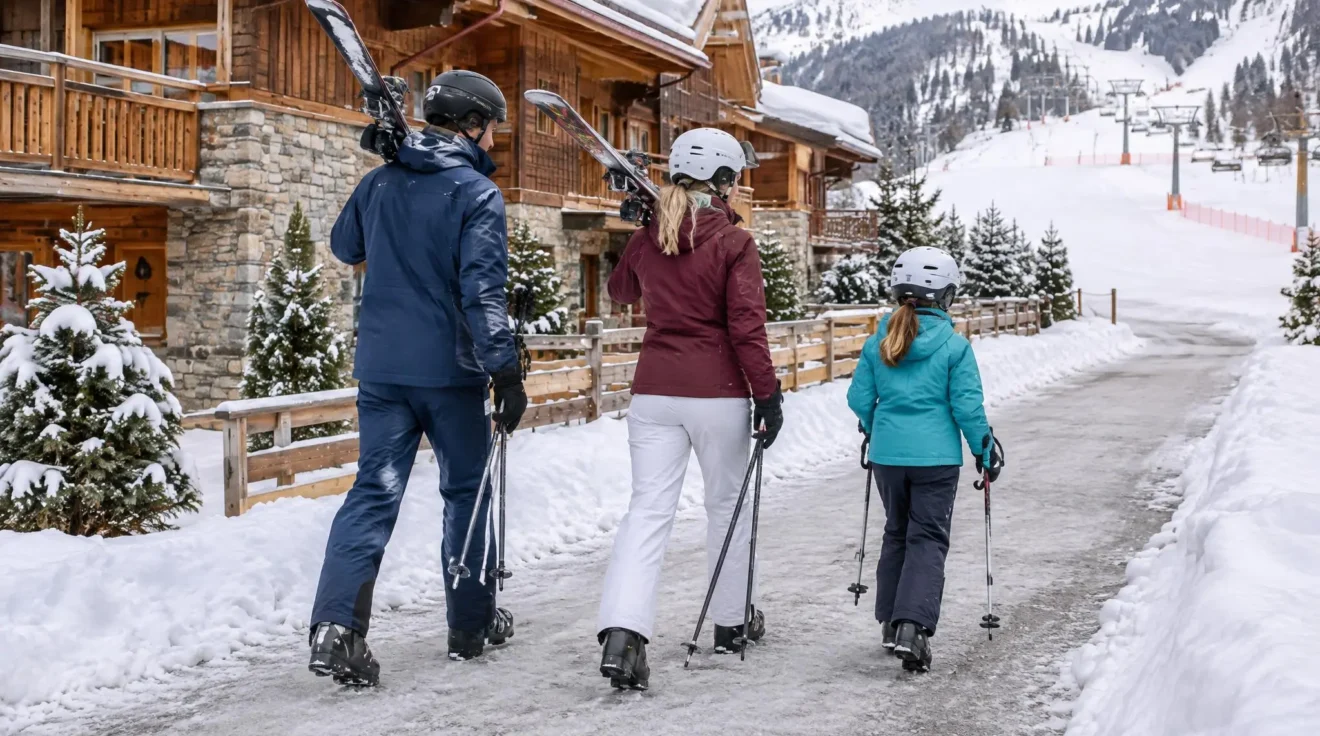
Courchevel also has free shuttle services connecting resort villages and some surrounding residential areas. Where a chalet depends on a shuttle, ask for the nearest relevant stop, the applicable timetable and the route to the lift you intend to use.
Shuttle access may be a reasonable compromise, but it should be compared as a transport arrangement, not described as skiing directly to and from the chalet.
What to confirm before booking
Maps establish the resort infrastructure; the rental provider can clarify how that infrastructure connects to the individual property. Request precise answers in writing so that you can compare the accommodation’s stated access arrangements with your expectations.
- What is the exact map pin for the chalet’s ski entrance?
- Which named piste or lift is used when setting off?
- Which route brings guests back to the property?
- Are there stairs, paths, road crossings or walking sections?
- Are the connecting pistes suitable for everyone in the group?
- Which lift, piste or snow conditions could prevent direct access?
- What walking or shuttle alternative is available if the route closes?
Where possible, request the names of the relevant pistes and a marked route on a map. This makes the response specific enough to compare with the resort information. Written clarification records the access arrangement described by the provider, although it cannot guarantee future weather or lift operation.
The best booking decision comes from verifying both journeys, not trusting a label. Choose a chalet whose departure route, return route, piste difficulty and possible alternatives are clear and suitable for your group. That is the practical difference between accommodation advertised near the slopes and access you can realistically plan to use.