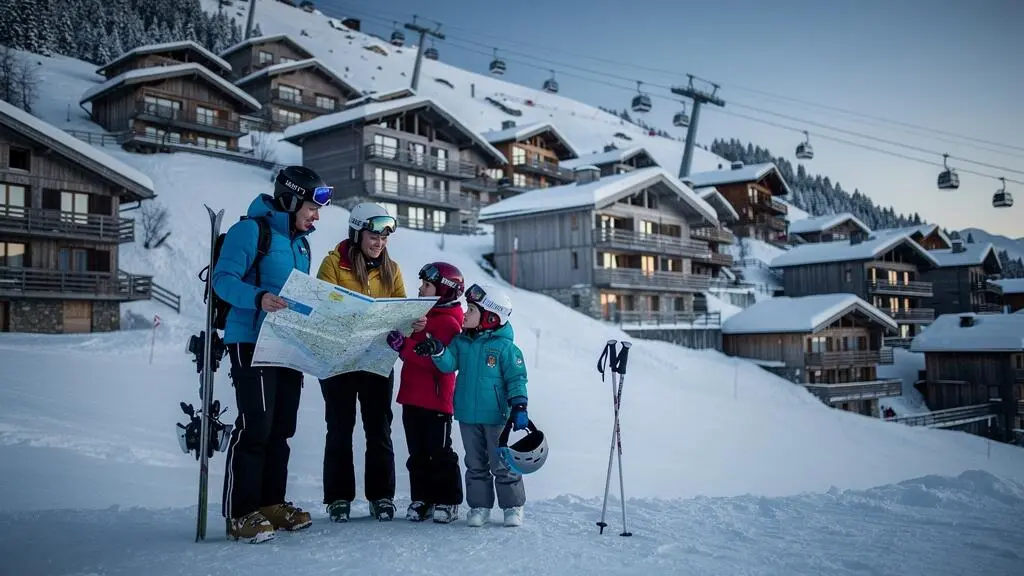
Finding the right Courchevel holiday rental means comparing more than accommodation prices. The resort comprises several villages at different altitudes, with distinct atmospheres, lift connections and distances from ski schools, restaurants and everyday services. A chalet in Courchevel 1850 may offer convenient access to particular slopes and an extensive choice of restaurants, while an apartment in Le Praz or La Tania may provide a different balance of space, tranquillity and cost.
The best location depends on who is travelling, how confidently everyone skis and how much time the group wants to spend moving between accommodation and the slopes. Families with young children may prioritise ski-school meeting points, whereas experienced skiers may value direct connections to the wider Trois Vallées area. Group size, bedroom arrangements, parking and transport also influence the real cost of a week.
A reliable comparison therefore combines village geography, verified property access and the complete holiday budget. These checks help distinguish a genuinely convenient rental from an attractive listing whose location creates additional daily logistics.
Courchevel Holiday Rental: Key Points
- Compare Courchevel’s six villages by altitude, lift connections, atmosphere and proximity to the facilities your group will actually use.
- Verify the exact walking route to the nearest lift and ski-school meeting point rather than relying on ski-in ski-out descriptions.
- Calculate the complete weekly cost, including accommodation, ski passes, lessons, cleaning, transport and parking, before choosing between a chalet and an apartment.
- Why Can Staying in Courchevel 1850 Cost More Than Staying in Courchevel Village?
- How Can You Check Ski-Lift Access Before Booking a Chalet for Beginners and Experts?
- Chalet or Apartment in Courchevel: Which Works Better for Eight Travellers?
- The Ski-in Ski-out Booking Mistake That Can Add a Daily Walk in Courchevel
- When Should Families Book Courchevel Accommodation for Peak Ski-School Weeks?
- How Can You Check the Condition of Ski Lifts and Resort Facilities Before Buying?
- Holiday Cottage or Resort Apartment: Which Offers More Privacy for Family Breaks?
- Which Holiday Rental Guest Questions Should Owners Answer Before They Are Asked?
Why Can Staying in Courchevel 1850 Cost More Than Staying in Courchevel Village?
Staying in Courchevel 1850 can cost more because the village has an established luxury accommodation market, an extensive selection of high-end restaurants and boutiques, and access to particular premium resort facilities. Its altitude and location also appeal to visitors seeking convenient connections to selected ski sectors. However, a higher rental price does not automatically mean better skiing or a more suitable holiday. Courchevel Village, Moriond, Le Praz and La Tania can offer practical alternatives depending on the group’s priorities.
Courchevel is made up of six villages distributed along the mountainside. Their geographical differences help explain why accommodation searches should start with location rather than a resort-wide average price.
The main villages in the comparison are:
- Courchevel 1850 (1,850 m): Associated with luxury hotels, premium chalets, high-end restaurants, boutiques and an active evening scene.
- Courchevel-Moriond (1,650 m): A sunny plateau setting with mountain views and access to the wider resort.
- Courchevel-Village (1,550 m): A family-oriented location with nearby lifts and ski access.
- Courchevel-Le Praz (1,300 m): A quieter, traditional village with rustic architecture and a more residential atmosphere.
- Courchevel-La Tania (1,400 m): A forest setting with a car-free resort centre and a family-friendly character.
Saint-Bon, at 1,100 m, completes the resort’s six-village structure. The Les 3 Vallées‘ Courchevel resort profile describes the villages, their altitudes, individual characteristics and connections by ski routes and free buses. These geographical distinctions provide a useful starting point, but they do not establish the rental price of an individual property.
The price difference between two rentals can reflect several factors beyond altitude. A property close to a main lift, a ski-school meeting point or a popular restaurant may command a different rate from an apartment on the edge of the same village. Floor level, building access, views, outdoor space and the presence of an elevator can also influence the comparison.
To evaluate the 1850 premium, calculate the complete weekly holiday cost rather than comparing nightly accommodation rates alone.
| Village | Altitude | Potential advantages | Points to verify |
|---|---|---|---|
| Courchevel 1850 | 1,850 m | Luxury accommodation, restaurants, boutiques and selected lift connections | Property-specific piste access, rental premium and parking |
| Moriond | 1,650 m | Sunny setting, family facilities and mountain views | Distance to lifts, ski schools and evening services |
| Courchevel Village | 1,550 m | Family-oriented atmosphere and nearby ski access | Exact walking route and return connections |
| La Tania | 1,400 m | Forest surroundings and car-free resort centre | Lift operating hours and connections after skiing |
| Le Praz | 1,300 m | Traditional village character and quieter accommodation | Vertical connections and transfer requirements |
A useful budgeting method is to add the accommodation, ski passes, lessons, equipment hire, transfers, parking and any additional property charges. The 2026–2027 six-day adult solo Trois Vallées pass is listed at 421 €, while the six-day child solo pass is listed at €345. These are separate ski-pass costs, not accommodation-inclusive holiday prices, and eligibility conditions should be checked before budgeting.
Then estimate the practical cost of the cheaper location. A lower rental rate may require more shuttle journeys, additional walking or greater flexibility around lift closing times. Conversely, paying more for 1850 may offer little practical benefit to a group that spends most of its time in a different sector.
The most suitable village is the one that reduces unnecessary travel while preserving the facilities and skiing experience the group values. The next step is to check whether the property’s actual lift connections support every skier’s ability level.
How Can You Check Ski-Lift Access Before Booking a Chalet for Beginners and Experts?
Check ski-lift access by identifying the nearest lift to the actual accommodation entrance, confirming its operating status and tracing the route it provides onto the piste network. For mixed-ability groups, verify two separate journeys: a beginner-friendly route to suitable slopes and ski-school meeting points, and an efficient connection for experienced skiers. A nearby lift is not necessarily the best lift for every member of the group.
Start with the official Trois Vallées interactive piste map. Locate the accommodation using its exact building name or address, then identify the nearest lift and its connection to the wider Courchevel ski area. The type of lift matters because gondolas, chairlifts and beginner drag lifts serve different purposes and do not provide identical access.
A gondola may offer a useful connection between village levels, while a chairlift can provide access to particular sectors. A beginner drag lift may be convenient for practising on gentle slopes but less useful as a starting point for advanced skiers seeking connections across the Trois Vallées network.
The official Courchevel lift and piste opening information provides an interactive map, live operating information and lift closing times. It is particularly useful for understanding how connections change throughout the day. However, the map does not establish the exact walking distance from a specific chalet or confirm that an accommodation listing genuinely offers ski-in ski-out access.
For beginners, the most important question is whether the accommodation provides a manageable route to gentle slopes and the correct ski-school meeting point. Trace the journey without assuming that a route suitable for an experienced skier will work for someone taking their first lessons.
For advanced skiers, check the onward connections towards the Trois Vallées network and the possibility of returning to the accommodation without relying on a lift that closes early. The final return journey deserves particular attention because different village connections do not necessarily operate for the same hours.
Lift availability is also conditional. Wind, snowfall, technical problems and operational decisions can affect individual lifts and pistes. A property close to one lift may become less convenient when that lift is unavailable, so identify an alternative connection and establish whether a free bus or other transfer is practical.
Before paying a deposit, ask the owner or agency for:
- The exact name of the nearest lift and the walking distance from the entrance.
- The route to suitable green and blue runs for beginners.
- The distance to the relevant ski-school meeting point.
- Alternative access if the nearest lift is closed.
- The applicable shuttle information and the return options after the final lift.
Also distinguish between a chalet situated directly beside a piste and one that is simply located in a ski-oriented neighbourhood. These descriptions can represent very different daily routines.
Once lift access has been established, the accommodation itself becomes the next decision. For a group of eight, the choice between one large chalet and two apartments can change both the budget and the way the holiday works.
Chalet or Apartment in Courchevel: Which Works Better for Eight Travellers?
For eight travellers, a chalet generally works better when shared living space, group meals and private leisure facilities are priorities. Two apartments may be more practical when travellers need separate bathrooms, independent arrival times or greater bedroom privacy. Neither option is automatically cheaper: the correct comparison includes the total property cost, occupancy rules, cleaning, linen, food, parking and the convenience of keeping everyone in one location.
A large chalet can simplify the social organisation of a group holiday. Everyone has access to the same living room and dining area, which makes shared breakfasts, evening meals and time together easier. Depending on the property, a private sauna, hot tub or games room may provide additional value after skiing.
However, a chalet advertised for eight people does not necessarily provide eight equally comfortable sleeping arrangements. Check whether the capacity includes sofa beds, bunk beds or rooms with shared bathrooms. Couples travelling together may have different expectations from families with children.
Two apartments in the same residence can offer a useful alternative. They may provide more independent bedrooms, additional bathrooms and flexibility for travellers who prefer different schedules. Separate accommodation can also reduce disagreements about noise, bedtime routines and shared responsibilities.
The financial comparison should use the total booking amount rather than the advertised nightly rate.
| Decision factor | One large chalet | Two apartments |
|---|---|---|
| Shared living space | Usually easier to organise everyone together | Shared time requires coordination between units |
| Bedroom privacy | Depends on the room layout | Separate units can provide greater independence |
| Bathrooms | Must be checked against occupancy | Potentially more independent facilities |
| Meals | Suitable for shared cooking or catering | More flexibility but potentially duplicated preparation |
| Additional facilities | May include private leisure facilities | May rely on residence facilities, if available |
| Booking logistics | One reservation and one property to manage | Two reservations and potentially separate conditions |
Staffing arrangements also matter. A catered chalet may include meal preparation and cleaning services, but guests should confirm which services are included and whether dinner times are fixed. A self-catered apartment provides greater control over meal schedules but requires grocery shopping, cooking and cleaning arrangements.
Food costs deserve attention in the overall budget. Shopping in a high-altitude resort location may be less economical than buying provisions in a valley supermarket before travelling up to Courchevel. However, the value of that saving should be balanced against car access, storage space and the time required to organise shopping for eight people.
Parking can also determine which property is practical. Courchevel has 13 car parks distributed across its six villages, but their existence does not establish that a particular rental includes a private space or guaranteed parking. Confirm the exact arrangement before booking.
For groups with different requirements, assess the following:
- Whether couples have sufficiently private bedrooms.
- Whether children can share rooms without compromising sleeping arrangements.
- Whether different skiing abilities require independent daily schedules.
- Whether anyone needs a dedicated parking space.
- Whether the group wants catered meals or independent cooking facilities.
A suitable layout and price are only part of the decision. The property’s relationship with the nearest piste must also be verified, particularly when a listing uses the term ski-in ski-out.
The Ski-in Ski-out Booking Mistake That Can Add a Daily Walk in Courchevel
The most common ski-in ski-out booking mistake is assuming that a property has direct slope access because the listing describes its residence or neighbourhood as ski-in ski-out. The phrase may refer to the wider building, a nearby piste or access that only works under particular snow conditions. The actual route from the accommodation entrance may still involve stairs, a path, a road or a walk to a lift station.
This distinction is particularly important in Courchevel, where accommodation is distributed across different village levels and terrain. A building can be close to a piste without providing a continuous skiable connection from the front door. Even properties within the same residence can have different access arrangements depending on their entrance, floor and position.
Before accepting a ski-in ski-out description, ask for the exact building name and the route used by guests in winter. Photographs should show the accommodation entrance and the actual connection to the slope, rather than only a distant view of the mountain or a piste-side building.
Use the official piste map to establish whether the route reaches a main ski run or a smaller connecting trail. Check whether the trail is accessible in both directions and whether it provides a practical connection to the lifts serving the group.
Seasonality introduces another limitation. A route may be skiable during a period of favourable snow cover but become difficult in early December or late March. Snow conditions, grooming and temporary piste closures can affect access even when a property is located close to the ski area.
The practical consequences are easy to underestimate. A daily walk of 10–20 minutes, for example, can become a significant inconvenience when repeated in ski boots with children and equipment. This is an illustrative scenario, not a measured average for Courchevel properties. The time can affect morning departures, lunch arrangements and the return journey at the end of the day.
There is also a difference between a property that offers direct ski access and one that offers convenient walking access to a lift. The latter can still be an excellent choice, provided the description is accurate and the price reflects the actual location.
Before booking, ask for winter photographs taken from the entrance, the exact address, the nearest piste name and the walking route when snow cover is insufficient. Check whether stairs, road crossings or changes in elevation are involved, particularly when travelling with young children or people carrying equipment.
Once the access claim has been verified, families should also consider when they are travelling. During school-holiday periods, the distance to ski-school meeting points can become more important than direct piste access.
When Should Families Book Courchevel Accommodation for Peak Ski-School Weeks?
Families travelling during peak ski-school weeks should identify their dates and preferred meeting points before selecting accommodation. French winter school holidays are staggered across three academic zones, creating several overlapping periods of increased demand. Properties close to suitable children’s facilities may be especially convenient, but actual availability and booking lead times must be checked directly with accommodation providers and ski schools rather than assumed.
The French school calendar is relevant to families travelling from France, but it is not a universal holiday calendar. British, Irish and other international families must also consider their own school terms, public holidays and travel schedules.
For the 2026–2027 academic year, the official French calendar establishes the following winter holiday periods:
| Academic zone | Holiday begins | Return to school |
|---|---|---|
| Zone C | 6 February 2027 | 22 February 2027 |
| Zone A | 13 February 2027 | 1 March 2027 |
| Zone B | 20 February 2027 | 8 March 2027 |
These dates are established by the official 2026–2027 French school-holiday calendar, published through Légifrance. The calendar confirms the three metropolitan academic zones and their respective winter periods. It does not provide Courchevel accommodation occupancy figures or prove when individual properties will sell out.
For family accommodation, the most useful booking strategy is to establish the children’s daily routine before comparing decorative features or additional leisure facilities. Identify the ski-school location, lesson start time, equipment collection point and route from the accommodation. A property that is a short walk from the correct meeting point may be more convenient than a piste-side apartment that requires a separate morning transfer.
Families should also confirm that the ski school offers the appropriate lesson level and language. A convenient location is not enough if the required programme is unavailable for the child’s age or ability.
Booking earlier can provide more choice, particularly when several families are travelling together and need specific bedroom arrangements. However, no fixed advance-booking period can be established from the supplied school calendar alone. Availability should be checked directly, and cancellation conditions should be compared before making a commitment.
Travelling outside the busiest French holiday periods can be an alternative for families with flexible dates. Before choosing an adjacent week, confirm that ski schools, equipment hire, children’s facilities and relevant lift connections operate according to the group’s requirements.
Five Checks Before Confirming a Family Ski Rental
- Confirm the dates: Prepare a travel-date calendar covering French school zones and the family’s own school holidays.
- Identify the ski-school location: Record the exact meeting-point address and the lesson start time.
- Measure the morning route: Save the walking distance and estimated journey time from the accommodation entrance to the meeting point.
- Verify children’s facilities: Obtain written confirmation of the relevant lesson level, language, age requirements and equipment arrangements.
- Compare the booking conditions: Save the total accommodation quote, cancellation policy, occupancy arrangements and any additional charges.
These checks produce a practical booking record that can be compared across several properties without relying on vague proximity claims or assumptions about seasonal availability.
Families are not the only travellers who need to evaluate resort facilities carefully. Buyers considering a Courchevel property for personal use or rental investment should apply similar access checks, while also examining long-term infrastructure and building costs.
Key Points to Remember
- The value of a Courchevel property depends partly on the reliability of the lift connections and services supporting its location, not simply its village name.
- Buyers should investigate planned infrastructure works, maintenance responsibilities and the year-round operation of essential facilities before estimating ownership costs.
- The same practical access criteria used by holiday renters can help assess a property’s long-term appeal to prospective guests.
How Can You Check the Condition of Ski Lifts and Resort Facilities Before Buying?
Before buying a property in Courchevel, investigate the condition, operating arrangements and planned investment in the lifts and facilities serving its immediate sector. A property’s apparent proximity to the ski area is not sufficient evidence of long-term convenience. Buyers should assess the infrastructure itself, review relevant building and co-ownership documentation, and understand whether planned works could affect access, ownership costs or rental appeal.
The first step is to identify which lifts and pistes make the property attractive to potential guests. A residence close to a particular gondola may depend heavily on that connection for convenient access to the wider resort. If the lift is scheduled for replacement, refurbishment or temporary closure, the effect on the property’s practical use deserves investigation.
Check the lift operator’s published information and investment announcements where available. Distinguish between confirmed projects, proposed works and general resort development discussions. An announced improvement should not be treated as completed infrastructure, and an anticipated closure should not be assigned an unsupported financial impact.
Resort facilities also require a seasonal assessment. A village may have different levels of activity in winter and summer, and services that appear essential during a ski holiday may not operate throughout the year.
Walk the immediate neighbourhood where possible. Assess the distance to the nearest lift, ski-school meeting points, shops, medical services and public transport. Repeat the visit in different seasons if practical, because a property can have a different level of convenience when the ski area is closed.
For an investment purchase, the property’s co-ownership documentation is another important source of information. Review meeting minutes, planned maintenance, financial statements and decisions concerning common areas. These records can reveal upcoming works, building maintenance responsibilities or possible changes to shared expenses.
Buyers should distinguish between infrastructure information and individual property information. An official resort map can establish the location of ski facilities, but it cannot confirm the condition of a private building, the financial health of its co-ownership or the future profitability of a rental.
Rental-income estimates should therefore be based on evidence about the individual property and its market, rather than on the resort’s reputation alone. Test the walk-to-lift route, verify the actual access conditions and compare the property’s facilities with the needs of its intended guests.
A useful due-diligence file should contain:
- The names and locations of the lifts serving the property.
- Available information about planned infrastructure works and operational changes.
- Seasonal opening information for relevant lifts and local facilities.
- Co-ownership meeting minutes and information about maintenance obligations.
- A documented assessment of the property’s access and rental suitability.
Infrastructure and rental appeal are only part of ownership suitability. Families and longer-stay guests may place equal importance on privacy, noise levels and the separation available within the accommodation itself.
Holiday Cottage or Resort Apartment: Which Offers More Privacy for Family Breaks?
A detached holiday cottage generally offers more physical privacy from neighbouring guests, while a well-designed resort apartment can provide better privacy between family members through separate bedrooms and bathrooms. The right choice depends on whether the priority is isolation from other households, quiet surroundings, independent sleeping arrangements or convenient access to village services and ski lifts.
These are two different forms of privacy. Physical privacy concerns the relationship between the property and its neighbours, including shared entrances, adjoining walls, outdoor spaces and common areas. Internal privacy concerns how comfortably family members can use different rooms without disturbing one another.
A detached cottage in Le Praz or La Tania may offer more separation from neighbouring accommodation, particularly if it has a private garden or terrace. This can be useful for families with young children who need naps, early bedtimes or a quieter environment after skiing.
However, a detached property is not automatically private. Nearby chalets may overlook its garden, neighbouring terraces may face the same outdoor area, and a shared driveway or entrance may reduce the sense of separation. Its location may also require additional travel to reach lifts, restaurants or shops.
A resort apartment may involve shared corridors, neighbouring units and traffic through communal facilities. These factors can reduce physical privacy, particularly in busy residences. Nevertheless, an apartment with distinct bedrooms, multiple bathrooms and a separate living area can provide an effective arrangement for a family with teenagers or several generations.
The most appropriate choice depends on the family’s daily routine.
- Families with babies or young children: A detached cottage can offer a quieter environment and greater flexibility around naps, provided the journey to services remains manageable.
- Families with teenagers: A central apartment may offer easier access to village facilities and greater independence.
- Several generations travelling together: Multiple bathrooms and separate sleeping areas may matter more than physical isolation from neighbours.
- Families seeking outdoor space: Check whether a garden or terrace is exclusive, shared or overlooked.
Photographs rarely establish these details reliably. Ask the owner whether the entrance is private, whether any rooms share walls with neighbouring units, and whether outdoor areas are reserved exclusively for the property.
Noise is another consideration. An apartment beside a lift station, restaurant or busy communal entrance may experience more movement than one in a quieter part of the residence. A detached cottage can still be affected by road traffic, neighbouring properties or shared access routes.
Privacy should therefore be assessed together with the practicalities of the location. A quieter cottage may involve longer journeys, while a central apartment may provide more convenient access to the ski area and everyday services.
Before making a decision, request a floor plan, confirm the bedroom and bathroom configuration, establish the ownership of outdoor spaces and ask for clarification about shared entrances and neighbouring properties.
Once location, facilities and privacy have been assessed, the final consideration is communication. Clear information from an owner or agency can resolve uncertainties before arrival and help travellers make a more confident booking decision.
Which Holiday Rental Guest Questions Should Owners Answer Before They Are Asked?
Holiday rental owners in Courchevel should answer questions about the exact location, lift access, ski-in ski-out conditions, ski-school distances, parking, bedroom arrangements and transport before guests need to ask. These details influence the suitability of a property for a particular ski trip. Clear, measurable information helps prospective guests compare accommodation accurately and reduces misunderstandings about what the booking actually includes.
Remote accommodation searches create a particular difficulty in Courchevel: a village name does not establish how convenient an individual property will be. Guests may understand the difference between Courchevel 1850 and Le Praz but still be unable to judge whether a specific chalet offers a practical route to their chosen lift.
Owners can address this uncertainty by providing an access fact sheet. It should identify the property’s exact village and building, the nearest lift, the walking distance from the entrance and the available alternatives when the usual connection is unavailable.
The wording should distinguish between measured walking distance, approximate journey time and direct piste access. If a route depends on snow conditions, say so explicitly rather than presenting ski-in ski-out as a permanent guarantee.
Family information deserves similar attention. Guests should be able to establish how many people can sleep comfortably in the property, whether bathrooms are shared, whether a cot is available and how far the accommodation is from the relevant children’s meeting point.
Parking and transport information should be equally precise. State whether parking is private, reserved, communal or subject to availability. Explain the location of the nearest bus stop where relevant, and provide shuttle information only when a current timetable or confirmed arrangement supports it.
Owners can organise the information into three practical sections:
Access fact sheet
- Village and exact property location.
- Nearest lift name and walking distance.
- Practical piste access and seasonal limitations.
- Distance to ski-school meeting points.
- Shuttle and parking arrangements.
Family and group fact sheet
- Maximum occupancy and actual bedroom configuration.
- Number of bathrooms and sleeping arrangements.
- Cot and child-friendly facilities, where available.
- Distance to ski schools and equipment hire.
- Shared or private outdoor and leisure facilities.
Honest limitations section
- Any walking distance between the building and the piste.
- Routes that depend on snow cover or lift operation.
- Stairs, shared entrances or access restrictions.
- Parking conditions and transport limitations.
- Facilities that are seasonal or available only on request.
This approach is also relevant to property owners considering a future sale or rental investment. The questions prospective guests ask are closely connected to the characteristics that make accommodation practical and attractive in a competitive resort market.
Clear communication does not guarantee a booking, but it gives prospective guests the information needed to decide whether the property matches their needs. It can also help establish realistic expectations before arrival, reducing the risk of disagreements about access, facilities or occupancy.
For owners, a useful final review is to compare the property description with the questions a first-time visitor would ask. If a guest has to contact the owner to establish the nearest lift, actual sleeping capacity or parking arrangement, that information should be easier to find in the listing.
For travellers, the most reliable booking decision comes from comparing verified access, group suitability and the complete weekly cost. For owners, the same criteria provide a practical framework for presenting a property accurately and responding to the concerns that influence accommodation choices.
Which Courchevel village is best for a family ski holiday?
Courchevel-Village is described by Les 3 Vallées as a family-friendly village with nearby lifts and ski access. Moriond and La Tania are also worth comparing, depending on the accommodation, children’s facilities and preferred skiing sector. Families should prioritise the exact distance to their ski-school meeting point rather than selecting a village based on its name alone.
Is Courchevel 1850 worth the additional accommodation cost?
Courchevel 1850 may justify a higher rental budget for travellers who value its premium accommodation, restaurants, boutiques and particular ski connections. However, the additional cost is not automatically worthwhile for every group. Compare the complete holiday budget, including ski passes, lessons, transfers and property charges, with the practical benefits of staying in 1850 rather than another Courchevel village.
Can you travel between Courchevel villages without a car?
Yes. The Courchevel villages are connected by ski routes and free buses, according to the resort’s official destination information. However, the most convenient connection depends on the time of day, the operating timetable and the location of the accommodation. Check the current transport arrangements before relying on a particular route.
When does the Courchevel 2026–2027 ski season open?
The scheduled opening of Courchevel’s ski lifts is 4 December 2026. Village, Moriond and La Tania are scheduled to open from 5 December 2026. The scheduled season end is 18 April 2027, with Moriond and La Tania separately indicated as closing on 11 April 2027. Actual lift and piste availability remains subject to operational conditions, weather and snow cover.
What should you check before booking a ski-in ski-out apartment in Courchevel?
Ask for the exact property address, the nearest piste name, photographs of the winter route from the entrance and confirmation of whether access depends on snow conditions. Check the official piste map and establish whether stairs, paths or road sections are involved. Also verify the nearest lift’s operating arrangements and the practical return route at the end of the skiing day.