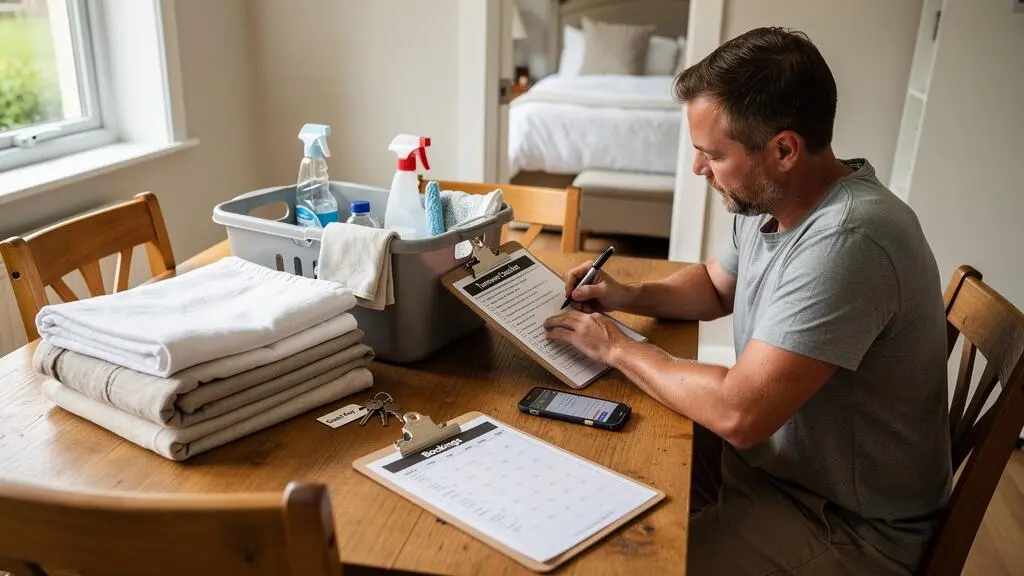
Managing a holiday rental alongside employment and family responsibilities is possible, but only when the property operates through a defined system rather than the owner’s constant availability. The challenge is rarely one individual task. It is the combination of guest communication, cleaning coordination, maintenance, booking administration and unexpected decisions that makes self-management feel like a second full-time job.
A sustainable operating model starts by identifying recurring responsibilities, assigning each task a frequency, and deciding which activities genuinely require the owner’s attention. Checklists, scheduled communication windows, reliable local contractors and simple digital tools can reduce interruptions without sacrificing guest experience. The right balance also depends on occupancy, property location and the owner’s available time.
The objective is not to eliminate every operational responsibility. It is to make the workload predictable, create backup arrangements for critical tasks and recognise when delegating becomes more sensible than doing everything personally. A well-organised holiday let should fit around an owner’s life, not continually compete with it.
The foundations of sustainable holiday rental management
- Organise cleaning, guest communication, maintenance and administration through repeatable checklists and scheduled work periods.
- Build a dependable local support network with documented backup arrangements for essential services.
- Measure the real cost of self-management and delegate tasks when workload, distance or service quality makes doing everything personally unsustainable.
- Why Does Running a Holiday Let Become Harder After Several Monthly Bookings?
- How Can You Create a Simple Operating Checklist for a Self-Managed Holiday Let?
- Self-Managed Holiday Let or Management Agency: Which Suits an Absentee Owner?
- The Single-Contractor Mistake That Can Leave a Holiday Rental Unavailable for Guests
- When Should a Holiday-Let Owner Hire Help Instead of Managing Every Stay?
- Why Can a 15% Holiday Rental Management Fee Cost More Than Expected?
- How Can You Set Up a Daily Task Board for a Busy Holiday Rental?
- How Can You Keep Daily Holiday Rental Operations Under Control from a Distance?
Why Does Running a Holiday Let Become Harder After Several Monthly Bookings?
Running a holiday let becomes harder as bookings increase because each reservation creates several connected responsibilities, not just another occupied night. Cleaning, guest messages, maintenance, check-in arrangements and administration accumulate, often overlapping with existing commitments. When stays are close together, even a small delay can affect the next arrival, making an informal management approach increasingly difficult to sustain.
At the beginning, owners often underestimate this effect. A few bookings may fit comfortably around a normal working week, particularly when guests stay several nights and turnover days are predictable. However, a calendar with more frequent arrivals introduces additional coordination. A cleaner may need access while the owner is working, a guest may request an early check-in, and a maintenance issue may arise just before another reservation.
The workload also compounds because some activities depend on others. Cleaning cannot be completed until guests leave, linen must be ready before the next arrival, and repairs may require access between those two events. Back-to-back stays leave little room for unexpected problems or deeper maintenance.
There is also a difference between physical work and decision-making work. Replacing supplies or checking a room takes time, but deciding how to handle a complaint, an unexpected cancellation or an urgent plumbing problem requires attention and judgement. These unpredictable decisions create a substantial mental burden, especially when the owner remains the only person authorised to resolve them.
Several warning signs indicate that the original operating model is no longer working:
- Guest messages regularly receive delayed responses because of employment or family commitments.
- Cleaning becomes rushed, with occasional omissions between consecutive stays.
- Maintenance is postponed because there is no convenient time to arrange access.
- The owner checks the booking calendar and inbox repeatedly throughout the day.
- Small operational decisions accumulate and remain unresolved until they become urgent.
Seasonal properties also have a second workload outside the booking calendar. Pricing reviews, listing updates, equipment maintenance, insurance renewals and applicable compliance requirements continue even when guests are absent. In England, for example, owners need to consider planning, taxation, insurance and property safety obligations as part of their annual operating arrangements.
These responsibilities should not be confused with a fixed amount of weekly work: their frequency and scope depend on the property and its jurisdiction. Nevertheless, excluding them from the original time calculation produces an unrealistic picture of self-management.
The practical response is to measure the entire operating cycle rather than counting only guest-facing tasks. Once the owner can see where work accumulates, it becomes easier to identify which activities should be standardised, batched or delegated.
More bookings do not automatically make self-management impossible. They reveal whether the existing processes have enough capacity, flexibility and support to accommodate a busier calendar.
How Can You Create a Simple Operating Checklist for a Self-Managed Holiday Let?
A self-managed holiday let needs a checklist that separates tasks by frequency and operational importance. The most useful structure has three levels: a mandatory turnover checklist for every departure, a recurring weekly or monthly checklist for administration, and a periodic checklist for maintenance and compliance. This makes responsibilities visible and reduces reliance on memory.
The first level covers everything that must happen before each new guest arrives. It should be sufficiently detailed for another person to complete the turnover without needing constant instructions from the owner.
- Cleaning and presentation: clean bathrooms, kitchen surfaces, floors and frequently touched areas; inspect bedrooms and communal spaces.
- Linen and supplies: replace bedding and towels, replenish essential consumables and check cleaning materials.
- Property inspection: identify damage, missing equipment, leaks and obvious maintenance problems.
- Guest readiness: verify heating, lighting, appliances, WiFi and access arrangements.
- Final handover: confirm that the property is secure, clean and ready for the next arrival.
The second level covers work that does not need to be repeated after every departure. Weekly or monthly activities can include checking upcoming reservations, reviewing prices, monitoring supplies, updating availability and processing administrative tasks. Grouping these activities into dedicated time blocks reduces the number of interruptions during the working week.
The third level covers less frequent but essential responsibilities. Deep cleaning, equipment servicing, property inspections, insurance renewals and applicable legal checks should have scheduled dates and a named person responsible for completion.
For owners in England, the government identifies several relevant responsibilities for self-catering holiday accommodation, including planning, taxation, fire safety, gas and electrical safety and insurance. The precise obligations depend on the property and circumstances. The UK government guidance on self-catering holiday-let regulations in England is a useful starting point for building the compliance calendar. These requirements should not automatically be applied to properties in Scotland, Wales, Northern Ireland or other countries.
Fire safety deserves particular attention. The Home Office provides dedicated guidance for small paying guest accommodation, including a property-specific risk assessment and a practical checklist. Owners should use the Home Office fire-safety guidance for small paying guest accommodation where applicable, rather than assuming that one generic checklist covers every building.
Another important distinction is between tasks that must happen immediately and tasks that can be batched. A broken entrance lock needs prompt attention; reviewing next month’s pricing can usually wait for a scheduled administration session. This separation prevents every notification from becoming an interruption.
Guest-facing details also deserve a place on the turnover checklist. Arrival instructions, reliable WiFi information, waste collection arrangements and emergency contacts can prevent avoidable questions and misunderstandings. These details are inexpensive to document but can materially improve the guest experience.
A checklist can also test whether self-management is genuinely viable. Record the time required for each task across two or three turnovers, include the administrative work, and compare the result with realistic booking frequency. This provides a more useful estimate than assuming that the first few stays represent the workload for an entire season.
Build a practical holiday rental operating checklist
- List every task required before arrival and after departure; deliverable: a written turnover checklist with an owner assigned to each task.
- Record weekly and monthly administrative responsibilities; deliverable: a recurring calendar with dates and time blocks.
- Schedule periodic maintenance and compliance activities; deliverable: an annual property-maintenance and safety calendar.
- Document guest essentials, including access, WiFi, waste collection and emergency contacts; deliverable: a guest information sheet and property handover document.
- Time two or three complete turnovers and calculate the workload at expected occupancy; deliverable: a realistic weekly self-management time estimate.
Once responsibilities are documented, the owner can decide whether to retain every task, involve local support or transfer more responsibility to a management agency.
Self-Managed Holiday Let or Management Agency: Which Suits an Absentee Owner?
An absentee owner should choose between self-management and an agency according to the property’s location, the availability of trusted local support and the ability to respond to unexpected problems. Distance changes the operational risks: an owner living far away cannot easily resolve a guest lockout, inspect damage or replace a contractor at short notice. The decision should therefore consider operational resilience as well as management fees.
Self-management gives the owner direct control over pricing, listing content, guest selection, house rules and communication. It can suit an owner who has sufficient time, reliable contractors and a clear process for handling emergencies. However, that control also comes with responsibility for coordinating every operational detail.
A management agency transfers some of that workload to an external provider. Depending on the contract, this may include guest communication, check-in coordination, cleaning arrangements, maintenance management and listing administration. The owner gains an operational buffer but may have less direct influence over decisions and service delivery.
The important comparison is not simply who charges less. It is who has decision-making authority, who responds when something goes wrong and which responsibilities remain with the property owner.
| Criterion | Self-management | Management agency |
|---|---|---|
| Pricing and listing | Owner retains direct control. | Agency may manage pricing and listing activity within agreed limits. |
| Guest communication | Owner handles enquiries and stay-related messages or delegates them separately. | Often included, subject to the service agreement. |
| Local emergencies | Owner needs an available local contact or contractor network. | May be coordinated by the agency, depending on coverage. |
| Operational costs | Separate contractor and software expenses. | Management fees plus any separately billed services. |
| Control | Higher direct involvement and decision authority. | Some operational decisions are delegated under agreed instructions. |
| Owner involvement | Potentially substantial, particularly without local support. | Usually lower, but not necessarily eliminated. |
There is also a useful middle ground. An owner can retain pricing, booking management and guest relationships while hiring a local cleaner and keyholder. Another option is to use a channel manager for distributing availability across booking platforms while managing guest communication independently.
These hybrid arrangements are particularly useful when only certain activities create pressure. They allow owners to buy back time without transferring control of the entire property.
For an absentee owner, the decision should begin with a simple question: how quickly can someone physically reach the property if a guest cannot enter or an urgent repair is needed? If the answer depends on the owner’s ability to travel, the operating model is exposed to unnecessary risk.
Before signing an agency agreement, examine the following:
- Which services are included in the management fee?
- Are cleaning, linen, laundry, maintenance and guest communication billed separately?
- Who approves repairs and additional expenditure?
- What response times and emergency arrangements are contractually defined?
- Who controls the listing, booking records, guest information and reviews?
- What happens to existing reservations and listing access when the agreement ends?
The contract should make responsibility clear rather than relying on informal assurances. An agency that manages guest messages but does not coordinate emergency repairs may leave the owner with significant operational exposure.
For owners who retain direct control, one further condition matters: the local operating network must remain functional even when an individual contractor is unavailable.
The Single-Contractor Mistake That Can Leave a Holiday Rental Unavailable for Guests
A holiday rental that depends on one cleaner, one keyholder or one handyman has a single point of operational failure. If that person becomes ill, takes leave or cannot reach the property, the owner may be unable to prepare the accommodation or resolve an urgent issue before the next arrival. A sustainable operation needs documented backup arrangements for its most critical services.
This dependency often develops naturally. An owner finds a reliable cleaner who knows the property, understands the access arrangements and can complete a turnover without supervision. Over time, that individual becomes the only person who knows where supplies are stored, how the heating works or which keys open the outbuilding.
The arrangement appears efficient until availability changes. A vehicle breakdown or unexpected absence can suddenly create a problem that affects guest access, cleaning quality and the booking calendar.
The solution is not necessarily to employ several full-time contractors. It is to identify which responsibilities genuinely require a backup and establish a simple alternative for each.
- Cleaning: identify a second cleaner who can cover urgent turnover dates.
- Key access: arrange an alternative keyholder or documented emergency access method.
- Repairs: maintain at least one alternative contact for urgent property issues.
Each backup should know how to access the property, where essential equipment is stored and how to report problems. A short handover document is usually more dependable than relying on one contractor’s memory.
The document should contain the relevant access arrangements, equipment locations, property-specific instructions, supplier contacts and escalation procedures. Sensitive information, particularly access credentials, should be stored securely and shared only with authorised people.
There is an important distinction between having a list of contractors and having an operational backup. A person who has never visited the property may not be able to take over a turnover at short notice. Backups should therefore receive enough information and, where appropriate, an initial walkthrough before an emergency occurs.
Consider this explicitly hypothetical scenario: a cottage has a guest checking in on Friday, but its regular cleaner becomes unavailable on Thursday evening. The owner is working several hours away. Without a second cleaner, documented access instructions or an alternative keyholder, the owner must either find an untested replacement or risk delaying the arrival. With those arrangements already in place, the backup can assess the property and complete the agreed tasks.
The practical test is straightforward: if the regular cleaner becomes unavailable tomorrow, can the property still be prepared for a guest arriving that evening? If not, the owner has identified a genuine operational weakness.
Once those arrangements exist, owners can assess whether additional paid help is necessary or whether a smaller amount of targeted support will be sufficient.
When Should a Holiday-Let Owner Hire Help Instead of Managing Every Stay?
A holiday-let owner should hire help when the time, risk or service-quality cost of completing every task personally becomes greater than the cost of delegating it. The clearest triggers are recurring communication delays, rushed turnovers, limited availability for emergencies and a booking calendar that leaves insufficient time for normal responsibilities. The right decision should be based on measurable workload and property economics rather than guilt or convenience alone.
One common mistake is to wait until an operational problem becomes serious. By that stage, the owner may be trying to recruit a cleaner, keyholder or maintenance contractor under pressure, without enough time to check availability, references or working arrangements.
Instead, establish a few practical thresholds in advance. These might include:
- Guest messages regularly exceed the owner’s planned response window.
- Cleaning quality becomes inconsistent during busy periods.
- Maintenance appointments repeatedly conflict with employment or family commitments.
- The owner has no reliable availability for emergencies.
- Administrative work occupies more time than the owner can sustainably allocate.
Guest communication is particularly important because platform expectations vary according to the message and its timing. Airbnb‘s ground rules for home hosts distinguish between ordinary enquiries and time-sensitive messages near check-in or during a stay. For example, its stated expectations include a one-hour response window for certain urgent messages during local daytime hours and a 12-hour window for other questions concerning an imminent or current stay. These are platform-specific expectations, not universal legal requirements or industry-wide averages.
Hiring help can also protect the quality of the guest experience. A cleaner who consistently prepares the property to the required standard may be a better investment than an owner attempting to complete every turnover after a full working day.
The financial comparison should include more than the contractor’s invoice. Consider the potential consequences of not delegating:
- Additional time spent travelling to the property or completing operational tasks.
- Lost availability when maintenance or cleaning cannot be arranged.
- Potential refunds or cancellations following an unresolved problem.
- Lower guest satisfaction if cleanliness or communication deteriorates.
- The opportunity cost of time that could be spent on employment, family or other responsibilities.
Three levels of support are available, depending on where the pressure occurs.
| Support level | Typical responsibilities delegated | Best suited to |
|---|---|---|
| Occasional help | Cleaning, linen changes, keyholding or emergency repairs. | Owners who can manage bookings but need practical local support. |
| Partial management | Guest communication, check-in coordination or contractor scheduling. | Owners who want to retain pricing and listing control but reduce daily interruptions. |
| Full management | Most agreed booking, guest-service and operational responsibilities. | Owners with limited availability or substantial distance from the property. |
The best starting point is usually the smallest delegation that removes the most significant bottleneck. If cleaning is the main source of pressure, hiring a cleaner may solve the problem without requiring an agency. If the owner cannot respond to guests during working hours, partial communication support may be more valuable.
Before committing to a permanent arrangement, compare the cost of occasional, partial and full support against the property’s actual operating margin and the owner’s available time.
Key decisions before building a remote operating model
- Determine which responsibilities genuinely need an owner’s judgement and which can be completed by a trained local contractor.
- Calculate the full cost of management, including separately charged services, rather than relying on a headline percentage.
- Establish a visible task allocation system and a reliable local response network before increasing the level of delegation.
Why Can a 15% Holiday Rental Management Fee Cost More Than Expected?
A 15% holiday rental management fee can cost more than expected because the advertised percentage may cover only a defined part of the service. Cleaning, laundry, linen, maintenance, photography, marketing and other charges may be billed separately. The actual cost depends on the fee calculation basis, the services included and the owner’s remaining profit after platform charges, taxes and property expenses.
The first question is what the percentage applies to. A fee calculated on accommodation revenue alone can produce a different result from one calculated on the entire booking amount, particularly when the guest also pays a separate cleaning charge.
Owners should therefore request a written explanation of the fee base and an itemised list of additional charges. Comparing two agencies using only their headline percentages can produce a misleading result if their service packages differ.
For example, consider a purely hypothetical booking with an accommodation charge of 1,000 £ and a separate cleaning charge of £100. A 15% management fee applied only to accommodation revenue would be £150. If the same percentage applied to the combined £1,100 booking amount, it would be £165. This illustration assumes those amounts form the relevant fee base; it is not a statement about standard agency practice.
The distinction becomes more important over multiple bookings. A small difference in the fee base or additional service charges can accumulate throughout a busy season.
There is also a difference between an inexpensive management package and a cost-effective one. An agency may advertise a lower percentage but charge separately for essential services or use more expensive contractors. Another provider may have a higher headline rate but include guest communication, operational coordination and other services that would otherwise need to be purchased individually.
Service quality must also be considered. A management arrangement that reduces the owner’s workload but results in unreliable cleaning, slow communication or poorly coordinated maintenance may create additional costs through refunds, lost bookings or extra supervision.
The most useful calculation is the total management cost per booking, not the percentage displayed in an advertisement.
| Cost category | Question to ask |
|---|---|
| Management percentage | Is the fee calculated on accommodation revenue or the total booking amount? |
| Cleaning and laundry | Are these services included or charged separately for each turnover? |
| Linen and consumables | Who pays for replacement linen and guest supplies? |
| Marketing and photography | Are listing creation, photography and promotional services included? |
| Maintenance | Are contractor visits, call-outs and emergency coordination billed separately? |
| Platform charges | Which booking platform fees remain payable by the owner? |
Finally, assess the fee in relation to the owner’s net income rather than gross booking revenue. The amount remaining after management fees, platform charges, operating expenses and applicable taxes may be substantially different from the initial booking figure.
For a meaningful comparison, calculate the amount retained under each management proposal using the same expected bookings, service requirements and expense assumptions. Tax treatment should be assessed separately according to the property’s jurisdiction and the owner’s circumstances.
Once the financial implications are clear, the remaining challenge is organising the day-to-day work so that both the owner and any external helpers can see what needs attention.
How Can You Set Up a Daily Task Board for a Busy Holiday Rental?
A daily task board gives holiday-let owners one visible place to organise urgent issues, scheduled work and recurring turnover responsibilities. A simple three-column structure — urgent today, scheduled this week and recurring every turnover — makes it easier to prioritise tasks, assign responsibility and prevent guest messages or maintenance requests from becoming an unmanageable inbox.
The first column should contain tasks that require action today. These might include a guest unable to access the property, a reported water leak, a cleaning issue before an imminent arrival or a contractor who needs approval to complete an urgent repair.
The second column contains work that needs to be completed within the current week but does not require immediate intervention. Examples include ordering supplies, reviewing upcoming reservations, arranging a maintenance visit and updating listing information.
The third column contains recurring activities that should happen whenever a specific operational event occurs. Turnover cleaning, linen replacement, property inspections and guest departure checks belong here.
| Urgent: Today | Scheduled: This week | Recurring: Every turnover |
|---|---|---|
| Resolve an access problem. | Review upcoming prices. | Complete the cleaning checklist. |
| Arrange an urgent repair. | Order replacement supplies. | Replace linen and towels. |
| Respond to a time-sensitive guest issue. | Schedule routine maintenance. | Check property condition and report damage. |
| Confirm an imminent arrival is ready. | Review administrative records. | Verify access and guest information. |
Every task should also have an owner, a deadline and a clear status. A simple board might use the following fields:
- Task description.
- Priority and required completion date.
- Person responsible.
- Current status.
- Relevant booking or property reference.
- Notes about the required action or outstanding decision.
This structure prevents the common inbox-chaos pattern. Guest messages should not automatically determine the entire working day simply because they arrive in chronological order. Instead, each message should be assessed according to urgency and operational impact, then transferred into the appropriate task category.
For example, an urgent lock problem needs immediate attention, whereas a general question about future availability can usually be handled during the next scheduled communication window.
The board should also connect to the owner’s other operational systems. The booking calendar identifies upcoming turnovers, guest messages reveal new requests, and the operating checklist supplies recurring tasks. These inputs should update the same visible work queue, whether through a basic shared document or a digital Kanban application.
Where a cleaner, keyholder or co-host is involved, shared visibility becomes particularly valuable. The owner can see whether a turnover is complete without requesting repeated updates, while contractors can understand what remains outstanding.
The task board also makes delegation easier. If several tasks repeatedly appear in the same category, the owner can identify a suitable responsibility to transfer to someone else. Work that was previously held in the owner’s memory becomes a visible process that another person can follow.
With the task allocation system in place, the final step is ensuring that the owner can monitor and coordinate the property even when physically absent.
How Can You Keep Daily Holiday Rental Operations Under Control from a Distance?
Managing a holiday rental remotely requires more than checking the booking calendar from a smartphone. A reliable remote operating model combines automated access with a documented fallback, a dependable network of local contacts and a structured communication system. These arrangements allow owners to oversee normal activity without remaining constantly available or travelling to the property whenever a minor problem occurs.
The first requirement is dependable guest access. Smart locks and key safes can simplify arrivals, but any electronic access system should have an alternative procedure. Owners should know how guests can enter if batteries run out, a keypad stops working or the connection fails.
Airbnb’s technical documentation explains how eligible hosts can configure a backup entry method for listings using connected smart locks. Its instructions for setting up a backup entry method provide a platform-specific example of how an alternative access procedure can be organised. This does not eliminate the need for a local contact who can intervene if the backup arrangement is insufficient.
The second requirement is a documented local support network. The owner should have named contacts for cleaning, key access and emergency repairs, with clear instructions about when each person should be contacted. Each contact should understand their responsibilities and the limits of their authority.
The third requirement is an automated messaging layer. Standard arrival instructions, departure reminders, WiFi details and answers to common questions can be prepared in advance and scheduled around booking events. Automation reduces repetitive communication, but it should not replace personal intervention when a guest reports a genuine problem.
These three components need to work together. A smart lock without a backup creates an access risk. An emergency contact without documented property information may struggle to help. Automated messages without monitoring can continue sending standard instructions while a guest is experiencing a serious problem.
Remote owners should therefore establish a monitoring routine that separates normal activity from urgent incidents. Rather than checking the inbox every hour, define one or two regular review windows that fit the property’s booking pattern and the owner’s availability. Genuine emergencies should follow a separate notification route.
Common failure scenarios should have documented responses:
- Smart lock failure: provide the agreed alternative entry procedure and contact the local keyholder if access remains unavailable.
- WiFi outage: identify the internet provider’s support route and a local person who can check the router and connections.
- Cleaner absence: contact the named backup and confirm whether the property can be prepared before the next arrival.
- Urgent maintenance: notify the designated contractor and define when the owner must approve expenditure or a more significant intervention.
- Guest complaint: acknowledge the issue, establish its severity and assign a person responsible for resolving it.
Every procedure should specify who acts first, who takes over if the initial contact is unavailable and when the owner needs to be informed. This avoids situations in which several people assume someone else is handling the problem.
The operating model should also define what the owner does not need to monitor personally. If a cleaner can confirm a completed turnover through a shared checklist, there is no need for repeated phone calls. If a guest receives standard arrival information automatically, the owner can reserve direct communication for questions requiring judgement.
The objective is not complete automation. It is controlled visibility: knowing what is happening, who is responsible and which problems require intervention.
For owners balancing a property with employment and family life, the most effective approach is to build a system that operates predictably without demanding constant attention. Start with the tasks that create the most interruptions, document how they should be handled and delegate the responsibilities that cannot be managed reliably from a distance. A holiday let should generate income without requiring its owner to remain permanently on call.
How many hours a week does it take to manage a holiday rental?
There is no universal weekly figure. The workload depends on occupancy, turnover frequency, property size, distance from the accommodation and the amount of work delegated to contractors. Owners should record the time required for cleaning coordination, guest communication, maintenance and administration across several bookings before estimating their actual weekly commitment.
Can one person manage a holiday let while working full-time?
Yes, provided the property has repeatable processes and reliable local support. Automated guest messages, scheduled administration, a documented turnover checklist and backup contractors can reduce interruptions. However, owners still need a clear arrangement for urgent guest issues and property emergencies that occur during working hours.
Is a property management agency worth the cost for one holiday rental?
An agency can be worthwhile when the owner’s time, distance from the property or operational risks justify the expense. The decision should compare the complete management cost with the services provided, the owner’s remaining income and the value of the time saved. A local cleaner or partial management arrangement may be more appropriate when only a few tasks need delegating.
What should a holiday rental owner automate first?
Start with repetitive, predictable activities such as booking confirmations, arrival instructions, departure reminders and routine guest information. Automated access can also simplify check-in when a suitable backup procedure exists. Keep human oversight for complaints, urgent maintenance, unusual guest requests and decisions that require individual judgement.
How can an absentee owner handle emergencies at a holiday rental?
An absentee owner needs named local contacts for access, cleaning and urgent repairs, together with written procedures explaining who responds first and when the owner must be contacted. A backup access method, secure property information and agreed contractor responsibilities help prevent minor failures from becoming serious booking problems. The arrangements should be tested before the next busy rental period.