Assessing a holiday property before purchase requires more than checking its appearance, location and asking price. A sound assessment examines the building’s physical condition, identifies defects that could require expensive repairs, evaluates its suitability for intermittent occupation and establishes whether the total ownership cost is financially manageable.
Holiday homes present particular inspection challenges. Properties left empty between visits or short-term bookings may experience unnoticed leaks, inadequate ventilation or maintenance problems that remain hidden during a carefully prepared viewing. Older cottages can also contain construction materials and structural features that require specialist investigation.
The most reliable approach combines an organised first viewing, an appropriately scoped professional survey, targeted legal enquiries and a realistic repair budget. Buyers should distinguish visible warning signs from confirmed defects, request further investigation when necessary and avoid treating an attractive interior as evidence of structural soundness.
Although the inspection principles apply broadly to holiday properties in English-speaking markets, the survey terminology and legal examples below primarily concern England and Wales. Buyers elsewhere should verify local disclosure obligations, inspection standards and transaction procedures.
Holiday home assessment: the essential decisions
- Inspect the building’s structure, moisture exposure, ventilation and services before allowing cosmetic improvements to influence the purchase decision.
- Choose a survey that matches the property’s construction and condition, then investigate significant defects before becoming contractually committed.
- Compare properties using acquisition costs, necessary repairs, ongoing maintenance and realistic financing assumptions rather than advertised prices alone.
- Why Can a Recently Decorated Holiday Home Still Need Expensive Structural Repairs?
- How Can You Inspect a Holiday Cottage for Damp, Ventilation and Water Damage?
- Basic Survey or Building Survey: Which Is Better for an Older UK Holiday Cottage?
- The Seller Disclosure Assumption That Can Leave Holiday Home Buyers Facing Repairs
- When Should You Arrange a Specialist Damp Survey Before Buying a Holiday Home?
- How Can You Compare Three Holiday Homes When Their Floor Areas and Features Differ?
- Seaside Cottage or Alpine Chalet: Which Faces Higher Long-Term Maintenance Costs?
- How Can You Build a Realistic Holiday Property Investment Strategy Without Overstretching?
Why Can a Recently Decorated Holiday Home Still Need Expensive Structural Repairs?
A recently decorated holiday home can still require major structural repairs because new finishes reveal little about the condition of concealed masonry, roof structures, foundations or timber. Fresh paint, replacement skirting boards and modern bathroom surfaces may cover earlier moisture staining or cracks. Buyers should therefore assess the underlying building independently of its presentation.
Cosmetic improvements are not inherently suspicious. Sellers frequently redecorate to improve marketability. However, isolated new finishes around previously damaged areas deserve closer examination, particularly where neighbouring surfaces remain visibly older.
Common places to investigate include freshly painted chimney breasts, walls behind large furniture, new skirting at ground-floor level, recently tiled shower enclosures and ceilings beneath bathrooms. These surfaces can conceal evidence of leaks, condensation or previous cracking without necessarily resolving the underlying cause.
Holiday homes also have distinctive occupancy patterns. Long periods without regular observation may allow small leaks, blocked gutters or deteriorating seals to remain unnoticed. Intermittent heating can contribute to condensation under certain moisture and ventilation conditions. Vacancy alone does not prove accelerated deterioration, but it increases the importance of checking how the property has been maintained while unoccupied.
A first viewing should include a visual comparison between decorative finishes and the building’s principal structural elements.
- Roof line: look for uneven ridges, sagging roof slopes, displaced coverings and visibly distorted gutters.
- Window and door openings: note stepped masonry cracks, distorted frames or doors that bind unexpectedly.
- Floors: identify noticeable slopes, springiness or changes in level between adjacent rooms.
- Chimney breasts: investigate staining, cracking and deteriorated plaster around fireplaces and flues.
- External render: check for substantial cracking, detached patches, staining and signs of trapped moisture.
None of these observations independently confirms structural failure. Older buildings may contain longstanding movement or uneven floors that are stable. Their significance depends on construction, progression and the surrounding evidence.
Repair costs and decorative costs can be radically different. Relatively inexpensive redecoration may obscure defects requiring extensive roof, masonry or timber repairs. A buyer should not assume that a visually attractive property has been comprehensively refurbished.
Where unexplained staining, distortion or cracking is visible, record its exact location and request professional investigation rather than estimating the repair cost from appearance alone. Moisture-related signs are particularly important because their causes and remedies can vary considerably.
How Can You Inspect a Holiday Cottage for Damp, Ventilation and Water Damage?
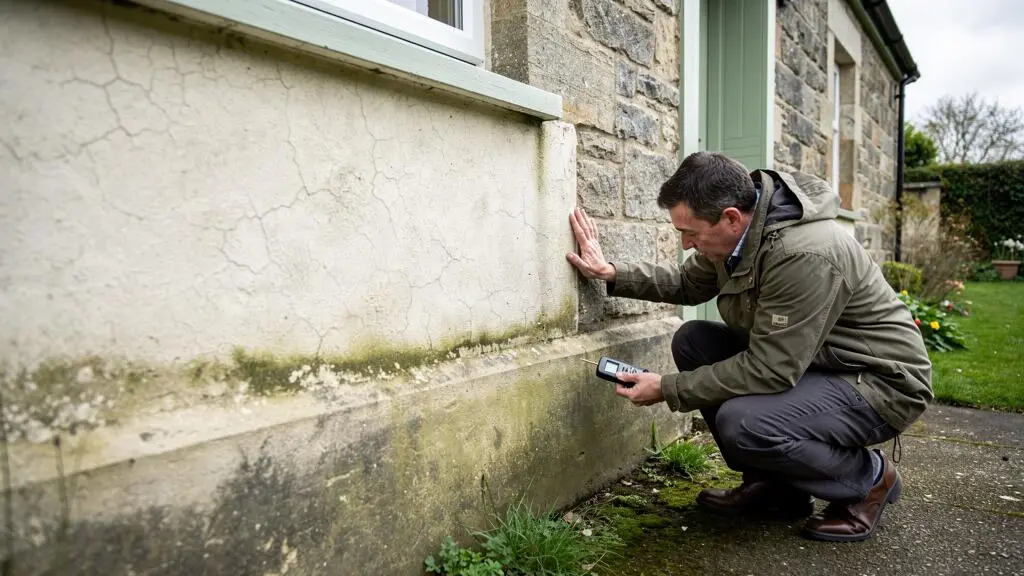
Inspect a holiday cottage for damp by examining external drainage and ground levels, checking vulnerable internal surfaces, assessing ventilation and looking for evidence of past leaks. A moisture meter can help identify areas for further investigation, but its readings cannot independently establish the cause of damp. The objective is to document warning signs for professional assessment.
Start outdoors. Observe whether surrounding soil, paving or planting appears to bridge an identifiable damp-proof course, where one exists. Check whether rainwater discharges away from the building, whether gutters show signs of overflow and whether external walls have concentrated staining beneath windows or roof junctions.
Traditional solid-wall cottages may not contain a conventional damp-proof course. Ground-level observations must therefore be interpreted according to the building’s age and construction rather than assuming a modern cavity-wall arrangement.
Inside, pay particular attention to ground-floor external walls, corners, chimney breasts and areas concealed by furniture. If the seller permits, inspect behind movable items and lift loose rugs to check for staining, deteriorated finishes or musty odours.
Use a basic moisture meter only as a comparative screening tool. Readings can be affected by salts, conductive materials, wall finishes and instrument type. Historic England‘s guidance on assessing damp in historic buildings explains why moisture measurement techniques require careful interpretation.
The location and appearance of moisture damage can provide useful clues, although several mechanisms may occur together.
| Damp type | Possible observations | Investigation priority |
|---|---|---|
| Rising damp | Low-level moisture patterns potentially associated with ground moisture movement | Establish the actual moisture source and exclude other causes before specifying treatment |
| Penetrating damp | Localised staining around defective roofs, windows, walls or drainage | Inspect the corresponding external defect and establish whether water ingress remains active |
| Condensation | Mould or surface moisture on cold walls, corners and poorly ventilated areas | Assess humidity, heating, insulation, airflow and thermal bridges |
Short-let occupation can complicate diagnosis. High moisture production during occupied periods, followed by closed windows and reduced heating while vacant, may create fluctuating indoor conditions. Recurring mould around cold corners may indicate condensation, but staining patterns are not conclusive without further investigation.
Where accessible and safe, observe loft insulation, visible roof timbers and any staining beneath roof coverings. Do not disturb insulation, enter unsafe roof spaces or undertake destructive inspection without permission and competent assistance.
Five actions to complete during a holiday cottage viewing
- Photograph each external elevation and visible roof slope; create a labelled exterior condition record.
- Inspect accessible wall bases, corners and spaces behind movable furniture; produce a room-by-room moisture observation sheet.
- Record any comparative moisture-meter readings with their locations and material types; prepare a measurement log without treating readings as diagnoses.
- Check visible ventilation openings, extraction arrangements and safely accessible loft areas; compile a ventilation and roof-space checklist.
- Document unusual odours, staining, cracking and signs of previous repairs; prepare a numbered defect list with photographs for the surveyor.
Persistent musty smells, low-level tide marks, staining beneath windows or unexplained roof-space moisture justify closer professional attention. The next decision is whether the building requires a routine condition survey or a more comprehensive assessment of its construction.
Basic Survey or Building Survey: Which Is Better for an Older UK Holiday Cottage?
A RICS Level 3 Home Survey, often called a Building Survey, is generally the stronger starting point for an older holiday cottage with complex construction, significant alterations or visible defects. A Level 2 survey may be adequate for a conventional property in reasonable condition. The appropriate choice depends on the building’s materials, condition and inspection requirements, not age alone.
In England and Wales, RICS survey levels provide a useful framework. RPSA surveys use their own product names and scopes, so buyers should not assume that every survey marketed as a basic, homebuyer or building survey offers identical coverage.
For traditional cottages constructed from stone, cob, timber framing or other non-standard materials, the surveyor’s experience with those techniques is especially important. A detailed report from someone unfamiliar with traditional building behaviour may be less useful than an appropriately scoped inspection by an experienced specialist.
The official RICS Level Three inspection scope describes the more extensive assessment of building materials, defects, remedial options and maintenance considerations. Inspection nevertheless remains subject to access, safety and other practical limitations.
The following decision grid provides a practical starting point. It does not replace a discussion with the surveyor about the precise scope of the instruction.
| Property circumstances | Suggested survey | Reason |
|---|---|---|
| Modern conventional property, apparently sound | Level 2 may be sufficient | Standard condition assessment without an identified need for detailed investigation |
| Older but substantially conventional property, no significant warning signs | Level 2 or Level 3 after discussion | Choice depends on condition, alterations and surveyor recommendations |
| Traditional stone, cob, thatch or timber-frame cottage | Consider Level 3 with relevant expertise | Construction-specific defects and maintenance requirements may need closer examination |
| Visible movement, persistent damp, timber decay or major alterations | Level 3 plus targeted specialist investigation where necessary | Potentially significant defects require diagnosis and repair planning |
A survey report is most useful when its findings are translated into decisions. Separate immediate safety concerns, material defects requiring repair, foreseeable maintenance and minor cosmetic issues. Obtain written quotations for substantial works before requesting a price adjustment.
Negotiation should be based on evidence. Roof repairs, defective drainage, significant timber decay or diagnosed moisture problems may provide a rational basis for renegotiation. Routine servicing and normal wear are less persuasive unless the agreed purchase price assumed a different condition.
Even Level 3 surveys are not guarantees against concealed defects. Surveyors generally cannot open walls, expose foundations, dismantle fixtures or comprehensively test services under a standard instruction. Ask about cellars, inaccessible roof spaces, solid-wall construction and specialist follow-ups before commissioning the work.
A survey can identify risks and recommend further investigation, but it does not resolve every uncertainty. Buyers must also establish what the seller knows, what has been formally represented and which questions remain unanswered before contracts become binding.
The Seller Disclosure Assumption That Can Leave Holiday Home Buyers Facing Repairs
The dangerous assumption is that a holiday home seller must voluntarily reveal every known or suspected defect. In England and Wales, buyers generally remain responsible for investigating property condition, although sellers must not make actionable misrepresentations and must answer relevant enquiries appropriately. Disclosure rules differ across jurisdictions, including Scotland, so the applicable legal framework must be confirmed.
The traditional principle of caveat emptor, or buyer beware, makes pre-contract investigation particularly important. It does not give sellers unrestricted freedom to provide false information or mislead buyers. Nor does it mean that every undisclosed defect automatically creates a successful legal claim.
Residential transactions in England and Wales commonly use the TA6 Property Information Form to record seller information about matters including disputes, alterations, environmental issues and services. The Law Society‘s TA6 explanatory notes explain the importance of accurate seller responses while making clear that buyers should obtain their own survey and appropriate legal advice.
The form does not establish the physical condition of every building element. Sellers may have limited knowledge of historic repairs, especially where a holiday home has been inherited, used intermittently or professionally managed.
Ask the conveyancing solicitor to raise specific written enquiries where the inspection or survey identifies uncertainty:
- Have damp, roof or timber repairs been undertaken, and are relevant reports, invoices or guarantees available?
- Have there been insurance claims or significant incidents involving flooding, escape of water or structural damage?
- Are there records of drainage problems, treatment works, alterations or building approvals?
- Have any survey reports or specialist investigations previously identified unresolved defects?
Search results should be considered alongside these responses. Rural holiday properties may involve private drainage, unusual access arrangements or site-specific constraints that require separate enquiries. Standard searches cannot be assumed to reveal every physical or environmental problem.
For properties with intermittent occupation, maintain an evidence file containing viewing photographs, survey findings, written answers, relevant searches and contractor quotations. This reduces reliance on informal verbal assurances.
Where a buyer enters a contract because of a qualifying misrepresentation and suffers loss, remedies may be available under the applicable law. However, proof of the representation, reliance, loss and other legal requirements is crucial. In many cases, discovering an ordinary defect after completion leaves the buyer responsible for repairing it.
Material inconsistencies should be resolved through the solicitor before exchange of contracts in an England and Wales transaction. If survey findings establish persistent moisture but do not identify its cause, a specialist inspection may be necessary before the buyer can make an informed decision.
When Should You Arrange a Specialist Damp Survey Before Buying a Holiday Home?
Arrange a specialist damp survey when visible moisture damage, unexplained staining or general survey findings suggest a potentially significant unresolved problem. Traditional solid-wall construction, coastal exposure and recent localised redecoration can strengthen the case for investigation when accompanied by relevant evidence. The specialist should identify the moisture mechanism before recommending repairs.
A general survey recommendation for further investigation is an important trigger, particularly where the surveyor could not establish whether moisture is active, historic or associated with a concealed defect.
Other reasons for targeted investigation include persistent odours, unexplained staining beneath windows, recurring mould, evidence of roof leaks and deteriorating ground-floor finishes. A cottage’s age or coastal location alone does not prove that it has a damp problem.
Independence matters. An investigator paid solely to diagnose moisture problems may have different commercial incentives from a contractor who earns revenue from installing remedial treatments. A treatment contractor can provide useful expertise, but buyers should understand how recommendations and quotations are generated.
Check the specialist’s relevant qualifications, insurance and experience with the property’s construction. Property Care Association (PCA) membership may be one useful professional credential, but membership should not replace scrutiny of expertise, methodology or potential conflicts of interest.
A usable damp report should establish:
- The affected locations and the evidence observed.
- The likely moisture sources and mechanisms, including alternative explanations.
- Whether the condition appears active, historic or uncertain.
- Any additional investigation needed before specifying remedial work.
- Recommended interventions, their priorities and a sufficiently detailed specification for obtaining comparable quotations.
Repair estimates should distinguish investigative work, essential repairs and optional improvements. A diagnosis that immediately recommends a chemical damp-proof course without establishing the source of moisture warrants particular scrutiny in a traditionally constructed building.
Timing also matters. Ordinarily, the general survey identifies issues requiring follow-up, and the specialist investigates them before the buyer becomes legally committed. Coordinate this sequence with the conveyancer and lender: a mortgage valuation is not a substitute for a condition survey, and valuation or offer deadlines vary.
The buyer commonly pays for commissioned investigations, even if the transaction fails, unless another arrangement is agreed. This should be considered a due-diligence expense rather than an assurance of purchase.
A dry summer viewing can also underrepresent moisture problems that appear during colder or wetter periods. Ask about historical staining, seasonal recurrence and monitoring where a single visit cannot establish the pattern.
Once defect severity and repair costs are reasonably established, the buyer can compare different properties on a consistent basis. This is particularly important when a cheaper cottage requires substantial work but a more expensive alternative is already in serviceable condition.
How Can You Compare Three Holiday Homes When Their Floor Areas and Features Differ?
Compare three holiday homes by standardising their usable floor areas, estimating their total acquisition costs and rating their suitability against the same weighted criteria. Price per square metre is a useful starting point, but it should not override building condition, repair liabilities, access, running expenses or the property’s intended use.
Begin with a consistent area measure. In the UK, an Energy Performance Certificate may provide a useful reference for recorded floor area, although EPC coverage, exemptions and measurement conventions require checking. Compare that information with floor plans and the actual layout.
Advertising descriptions may emphasise loft spaces, converted outbuildings or rooms with limited headroom that contribute little to practical accommodation. A cottage with a larger advertised area may therefore offer less useful living space than a smaller, better-designed property.
Where measurement conventions differ, request clarification rather than calculating misleadingly precise unit prices.
Next, compare properties using an identical scoring framework. The example below is an explicitly hypothetical assessment model; its weights are decision-making preferences, not published industry benchmarks.
| Criterion | Example weighting | Assessment basis |
|---|---|---|
| Physical condition and repair exposure | 30% | Survey findings, urgent repairs and maintenance liabilities |
| Location, access and remoteness | 20% | Travel practicality, trades availability and property access |
| Usable accommodation and layout | 20% | Functional rooms, accessibility and actual usable space |
| Running costs and maintenance | 20% | Utilities, insurance, servicing and ownership costs |
| Letting potential, where relevant | 10% | Documented demand, permitted use and realistic rental economics |
Score each property on the same scale, multiply each criterion score by its weighting and compare the totals. Buyers seeking personal enjoyment rather than rental income should reallocate the letting weight to criteria that better reflect their needs.
Features need similar scrutiny. Additional bedrooms, practical parking and appealing outdoor facilities may improve usability or letting prospects. Hot tubs, swimming pools, large grounds and private drainage systems can also create cleaning, safety, insurance and maintenance obligations.
Consider a hypothetical comparison in which Property A has an agreed price of £240,000 but requires £40,000 in structural works. Property B costs £265,000 and has no identified major immediate repairs.
Before transaction expenses and reserves, Property A’s estimated acquisition-and-repair cost is £280,000, compared with £265,000 for Property B. The apparently cheaper property is therefore £15,000 more expensive on that limited measure.
True acquisition cost should include the agreed price, transaction taxes and fees, professional inspections, essential repairs and a justified allowance for remaining uncertainty. Future maintenance and operating costs should then be assessed separately to avoid double-counting.
The strongest candidate is not necessarily the largest or cheapest. Its condition, layout and ownership obligations should fit the buyer’s intended use, including the maintenance demands created by the surrounding environment.
Seaside Cottage or Alpine Chalet: Which Faces Higher Long-Term Maintenance Costs?
Neither a seaside cottage nor an alpine chalet is automatically more expensive to maintain. Coastal properties face salt exposure, wind-driven rain and corrosion, while alpine buildings may experience snow loading, freeze-thaw damage and pipe-freezing risks. The higher-cost option depends on construction, local hazards, accessibility, condition and the maintenance systems already in place.
Coastal exposure can accelerate deterioration of vulnerable metal fixings, window components, exterior coatings and other materials. Salt-laden moisture and wind-driven rain may increase the frequency of inspection, cleaning and protective maintenance.
Alpine properties face a different set of risks. Snow accumulation, freeze-thaw cycles, roof drainage conditions and prolonged cold periods can create substantial demands on roofing, waterproofing and heating systems. The relevant risks vary by elevation, climate, orientation and building design.
A comparison should therefore focus on individual deterioration mechanisms rather than broad assumptions about seaside or mountain locations.
The following comparison identifies maintenance categories requiring property-specific quotations. No universal cost ranking can reliably be inferred from location type alone.
| Maintenance category | Seaside cottage | Alpine chalet |
|---|---|---|
| Exterior finishes | Salt exposure, coating deterioration and corrosion | Freeze-thaw effects, moisture exposure and timber protection |
| Roof and drainage | Wind-driven rain, exposed fixings and gutter deterioration | Snow loads, ice accumulation and drainage during thaw |
| Heating and water systems | Moisture management during vacant periods | Freeze protection, winterisation and reliable cold-weather heating |
| Insurance | Relevant coastal, flood and storm exposure | Relevant snow, avalanche and other local natural hazards |
| Contractor access | Potential access difficulties in exposed or isolated locations | Potential seasonal access restrictions and remote servicing |
Usage patterns add another layer. A coastal cottage left closed for extended periods may require ongoing ventilation and moisture management. An alpine chalet may need frost protection and periodic checks even when no guests are present.
Neither approach should rely solely on switching off utilities or leaving heating at an arbitrary setting. Winterisation requirements depend on the water system, climate, insulation and manufacturer instructions.
For each candidate, obtain a condition-based maintenance plan covering expected inspections, foreseeable replacement cycles and known vulnerabilities. Request relevant quotations and consider insurance terms, excesses and access constraints.
A generic annual reserve calculated as a fixed percentage of market value cannot adequately represent these differences. Instead, spread anticipated major works over reasonable planning periods and combine them with recurring servicing costs and a separate contingency for unexpected failures.
The resulting annual reserve is part of the property’s financial reality, even when it remains unused for much of the year. Incorporating it into the purchase decision helps distinguish a genuinely affordable holiday home from one whose operating demands exceed the buyer’s resources.
Key takeaways before making a financial commitment
- Use documented defects and independent repair quotations to establish a realistic purchase budget rather than relying on the advertised price.
- Build a property-specific maintenance reserve that reflects construction, environmental exposure and the practicalities of intermittent occupation.
- Test affordability against adverse conditions, including unexpected repairs, reduced rental income and continuing expenses during vacant periods.
How Can You Build a Realistic Holiday Property Investment Strategy Without Overstretching?
Build a realistic holiday property investment strategy by defining the property’s primary purpose, calculating its full acquisition and ownership costs, and stress-testing affordability before committing. Essential repairs, financing, insurance, management and periods without rental income must be affordable without relying on optimistic assumptions. A purchase is sustainable only when the property’s financial obligations fit the buyer’s available resources.
Start by identifying whether the holiday home is primarily intended for personal use, occasional letting or commercial rental income. These objectives influence location, layout, financing, management requirements and acceptable expenditure.
A family retreat may justify prioritising convenience, accessibility and personal enjoyment over rental yield. An income-focused property requires additional evidence about demand, permitted use, operating expenses and achievable net revenue.
Mixing objectives without assigning priorities can lead to unsuitable choices. A remote property may provide an excellent private retreat while requiring expensive guest management. A high-occupancy rental property may produce income but offer limited availability during preferred family holiday periods.
The financial model should distinguish acquisition spending from ongoing annual obligations.
| Cost category | What to include | Evidence required |
|---|---|---|
| Initial acquisition | Purchase price, applicable transaction taxes, legal fees and financing costs | Agreed terms, legal estimates and lender documentation |
| Initial works | Essential repairs, remedial investigations and necessary improvements | Survey reports, specialist findings and contractor quotations |
| Annual fixed expenses | Insurance, relevant property charges, finance payments and standing costs | Policy quotations, lender terms and local obligations |
| Variable operating expenses | Utilities, cleaning, management, servicing and occupancy-related expenditure | Service quotations and realistic usage assumptions |
| Maintenance and contingency | Planned replacement works and unexpected repairs | Condition-based maintenance schedule and available reserves |
For personal use, calculate annual ownership expenditure and divide it by the number of weeks realistically expected to be spent at the property. This produces an indicative cost per week of use, although capital appreciation, resale proceeds and alternative accommodation costs require separate consideration.
For a rental-focused property, estimate net operating income after realistic vacancy, management, utilities, cleaning, maintenance and other applicable costs. Do not treat gross booking revenue as spendable profit.
Lenders may assess second homes and holiday lets under different criteria. Deposit requirements, income assessments and permitted letting conditions vary by product and jurisdiction. Obtain financing terms that reflect the intended use rather than assuming an ordinary owner-occupier mortgage is suitable.
The financial stress test should examine whether the buyer can continue meeting obligations during a prolonged period without rental income and fund a major unexpected repair. Consider sensitivity to changes in borrowing costs, insurance premiums and property management expenses.
A clear implementation sequence reduces duplicated work:
- Define the intended use, location requirements and maximum affordable commitment.
- Conduct structured viewings and record visible structural, moisture and functional warning signs.
- Commission a suitable general survey and arrange specialist follow-ups for material uncertainties.
- Review the seller’s information, searches and targeted enquiries with the relevant legal professional.
- Obtain repair quotations, compare total acquisition costs and establish ongoing maintenance budgets.
- Complete financing and cash-flow stress tests, then decide whether to proceed, renegotiate or withdraw before becoming contractually bound.
Withdrawal can be a sound financial decision when risks remain unquantifiable or essential repairs exceed available reserves. Equally, documented defects do not necessarily make a purchase unsuitable if their causes, costs and implications are understood and reflected in the agreed terms.
Prepare a final pre-commitment decision sheet showing the agreed price, unresolved defects, confirmed repair quotations, survey limitations, annual ownership costs and available contingency funds. Share outstanding technical and legal questions with the appropriate professionals before proceeding. The goal is not a property without maintenance needs, but a purchase whose physical condition, intended use and financial consequences are sufficiently understood.
Can a buyer inspect a holiday cottage more than once before making an offer?
A buyer can request additional viewings, although access depends on the seller’s agreement and the transaction arrangements. A second visit can help check previously inaccessible areas, assess functional suitability and compare observations under different weather or occupancy conditions. It does not replace a professional survey.
Should a holiday home be inspected while its heating and water systems are running?
Where feasible and permitted, observing the normal operation of heating, taps, drainage and ventilation can reveal practical concerns. However, apparent operation does not establish technical safety or reliability. Buyers should arrange appropriate specialist checks where necessary, particularly when systems have remained unused for extended periods.
Does a mortgage valuation confirm that a holiday property is structurally sound?
No. A mortgage valuation primarily serves the lender’s assessment of the property as security. It is not equivalent to a buyer-commissioned condition survey and may not identify concealed structural defects, moisture problems or future maintenance liabilities. The inspection and report scope should be confirmed separately.
What should happen if a major defect is discovered shortly before exchange of contracts?
The buyer should inform their solicitor, obtain appropriate professional advice and establish the likely repair scope before deciding whether to continue. Depending on the circumstances, possible responses include requesting further investigation, renegotiating the price, changing contractual arrangements or withdrawing. In England and Wales, the distinction between exchange and completion is particularly important because exchange normally creates binding contractual obligations.
How can buyers assess defects that are not visible during a dry-weather viewing?
Ask about previous water ingress, review available repair and maintenance records, inspect external drainage arrangements and consider whether a specialist recommends monitoring or additional investigation. Seasonal moisture problems may not be apparent during a single inspection. Where significant uncertainty remains, buyers should account for it explicitly rather than assuming that the absence of visible staining means the property is dry.